Scientific description
MIKE MS is a MIKE Cloud application for modelling high-resolution nearshore and offshore wave conditions. MIKE MS applies statistical methods to get radically faster results than traditional modeling. It applies high-quality data from MIKE Data Link, removing effort for modelers. MIKE MS leverages cloud infrastructure to remove hardware investment, increasing cost-effectiveness. It is powered by recognized MIKE software MIKE 21 SW – quasi stationary formulation.
MIKE MS follows the scientific basis defined by Camus et al (2013)(1), and is implemented by DHI as shown in the figure below. The diagram shows the sequence of obtaining boundary conditions and selecting a subset of the events by using principal component analysis (PCA) and maximum dissimilarity analysis (MDA). At completion of the modelling of the selected events the full timeseries is reconstructed using a radial basis function (RBF).
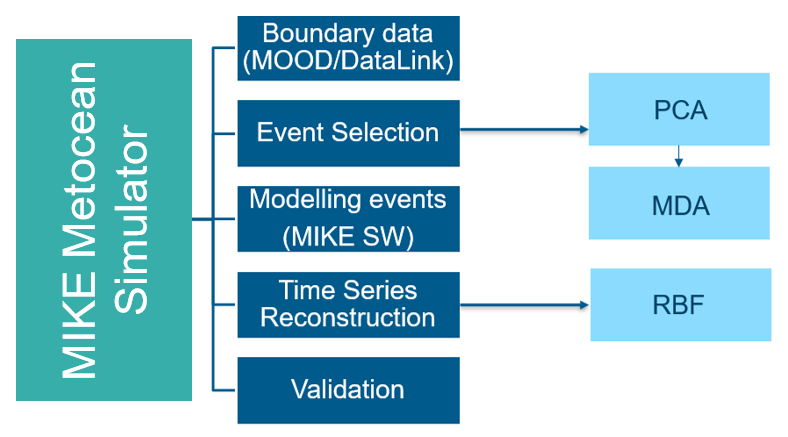
MIKE MS simulation process
Data extracted along the boundaries of the model include significant wave height, peak wave period, mean wave direction and directional standard deviation for total, wind sea and swell wave components. Data extracted over the domain include directional wind vector components as well as predicted tides.
The event selection (PCA and MDA) makes use of all the extracted parameters along all boundaries and over the domain.
An example of a comparison between a MIKE MS model run using 100 events and a model run simulating all timesteps and using an instationary formulation is shown in the figure below, for a location off the US west coast.
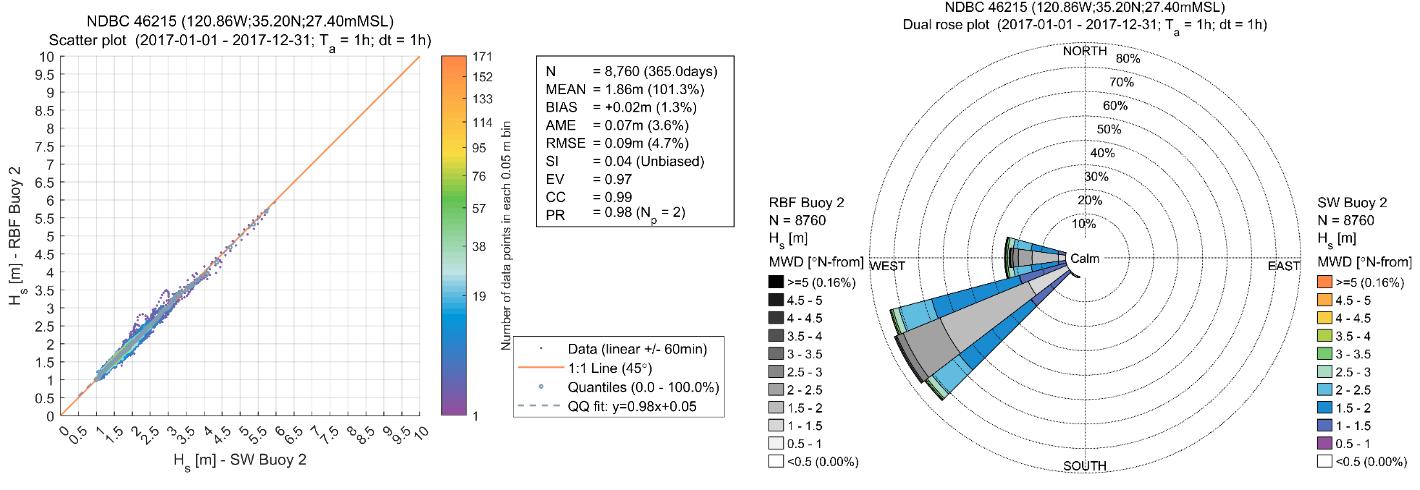
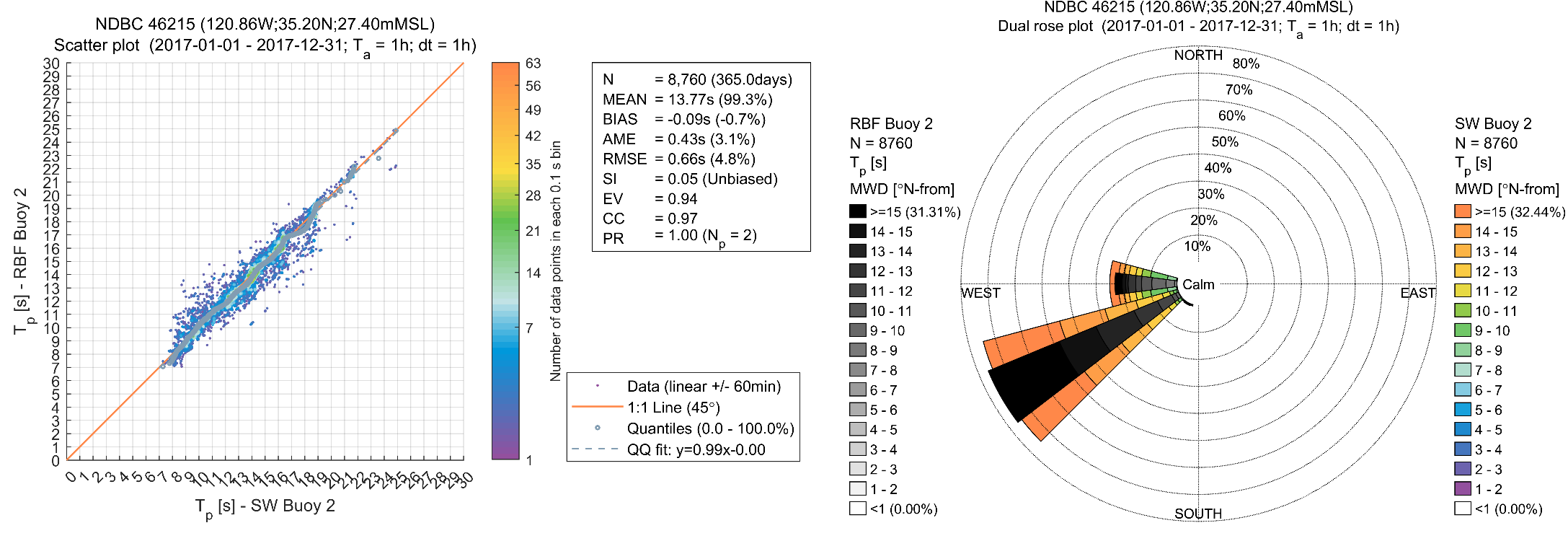
Comparison of a MIKE MS run using 100 events against a detailed model run simulating all timesteps and using an instationary formulation. Comparison plots show significant wave height [m] (top) and peak wave period [s] (bottom) for a location off US west coast. Note this is a model to model comparison.
(1): Camus, P., Mendez, F. J., Medina, R., Tomas, A., & Izaguirre, C. (IH Cantabria 2013). High resolution downscaled ocean waves (DOW) reanalysis in coastal areas. Coastal Engineering, Volume 72, Pages 56-68.).